
Watching the Scenery Change Around Dotonbori, Osaka, Together: From Minamihorie to the Bustle of Minami by Street Kart and on Foot
Watching the Scenery Change Around Dotonbori, Osaka, Together: From Minamihorie to the Bustle of Minami by Street Kart and on Foot
By a café window, you can hear the soft clink of someone setting down a cup. The streets of Minamihorie in Osaka are that quiet. Dotonbori, though, is only about a 20-minute walk away. In those 20 minutes the city turns into a block of vintage clothing shops, then a long roofed shopping street, and finally a riverside lined with huge signs. If the two of you are traveling in Osaka with limited time, you shouldn't miss how quickly the scenery shifts over such a short distance. You can zip through it all in a kart, or wander at your own pace on foot. This article follows the route a local would take from Minamihorie, home of Street Kart's Osaka store, to the Dotonbori area, and describes how the scenery changes along the way.
How Many Times Does the Scenery Change in the 20 Minutes from Minamihorie to Dotonbori?
Street Kart's Osaka store is in Minamihorie, in Osaka's Nishi Ward. The area is full of stylish shops and cafés. If you know Tokyo, the feel is a lot like Daikanyama or Ura-Harajuku. The buildings aren't very tall, and people on the street stroll along at a relaxed pace while they shop. You can see into the stores through the glass, and clothes and small goods in the shop windows catch your eye as you pass. First-time visitors would hardly guess they're right next door to Osaka's Minami district.
A quick detour: people in Osaka divide the city's nightlife and shopping districts into "Kita" (North) and "Minami" (South). The Umeda area is Kita, and the stretch from Shinsaibashi to Namba is Minami. The names are less about compass directions and more about each area's character. Say "Minami" and people picture somewhere lively, with great food, and a little bit loud. The walk we're about to take runs from the edge of Minami right into its heart.
Now, back to the route. About 5 minutes on foot from the store, you enter Amerikamura (America Village). Suddenly there are far more vintage clothing and streetwear shops, and the signs get bolder in color and lettering size. At the center is Triangle Park, where people gather and chat, and you can hear the volume of the street go up a notch from Minamihorie.
Keep going and you reach Shinsaibashi. About 15 minutes on foot from the store is Shinsaibashi-suji Shopping Street, one of Osaka's best-known shopping streets. In Japanese, a shotengai is a shopping street lined on both sides with small shops. When it's a covered shopping arcade, the street looks like one long tunnel. Crowds move in the same direction, and the chatter around you echoes back off the roof. That buzzing echo is your signal that you've arrived in Minami.
Come out the other end and you're in Dotonbori. The roof suddenly disappears, the sky and the river open up, and huge signs line the building walls. Counting from the quiet of Minamihorie, it should feel like you've entered three or four different towns by now. What makes Osaka's Minami so interesting is how fast it changes. If you hop on the subway straight to one landmark, you'll miss all of that.
Dotonbori's Signs Look Different Depending on the Color of the Sky
The best-known photo spot in Dotonbori is the Glico sign. There's also the Kani Doraku crab sign and Kuidaore Taro. A bit of trivia while we're at it: the name "Dotonbori" comes from Yasui Doton, the man who dug this canal. His name became the name of the river and the district, and it has stuck for centuries. Knowing that, the river might look a little different when you peer into it.
Back to the signs. You may have seen them all in photos, but when I stand in front of the real thing, I still think, "Wow, they really are big."
In daylight, you see the signs for their shapes and colors. With the Kani Doraku sign, you can clearly see how three-dimensional it is and how far it sticks out from the building wall. You can make out every detail of Kuidaore Taro's expression, too. Photos taken at this time of day work as a record of what's where.
As the sky darkens, the light from the signs takes over. The outlines of the buildings fade into the dark, and only the colors of the signs float in the night. When the lights reflect on the river, you can get shots with the same colors above and below. It's the same place, but photos taken in daylight and after dark look like two different cities.
Keep in mind that when it gets dark varies a lot by season. Some seasons it gets dark early, and in others it stays light for a long time. There's no fixed time when you're guaranteed to see the neon, so check the sunset time for your travel day in a weather app. The day's weather and cloud cover also change the color of the sky. Honestly, the part I never get tired of watching is the in-between, while the light is still changing.
Looking Up from the Dotonbori River Promenade
If you're taking photos in Dotonbori, head down to the Dotonbori River promenade. From street level, the signs are almost directly overhead. From the riverside promenade, you look up at them from a bit farther away, which makes it easier to fit the signs, the buildings, and the river into one shot.
For two people traveling together, the go-to shot is for one person to step back and photograph the other with a sign. A vertical frame works well if you want the whole sign in the picture, and a horizontal one if you want to include the river and the passing crowds. Besides taking photos of each other, you can ask a passerby to take one of you together. Say "Shashin, totte moraemasu ka?" ("Could you take a photo for us?") in Japanese and people will understand. Usually just holding out your phone and pointing at the screen works too.
A common thing among overseas visitors is getting so caught up in taking photos that they stop in the middle of the promenade. Dotonbori is crowded, and there are people walking along the promenade as well. When you take photos, step to the side so you're not in the way of people coming up behind you. I don't think this is a Japanese etiquette thing so much as something that applies to anyone taking photos in a crowded place.
How Is the Scenery Different by Kart Than on Foot?
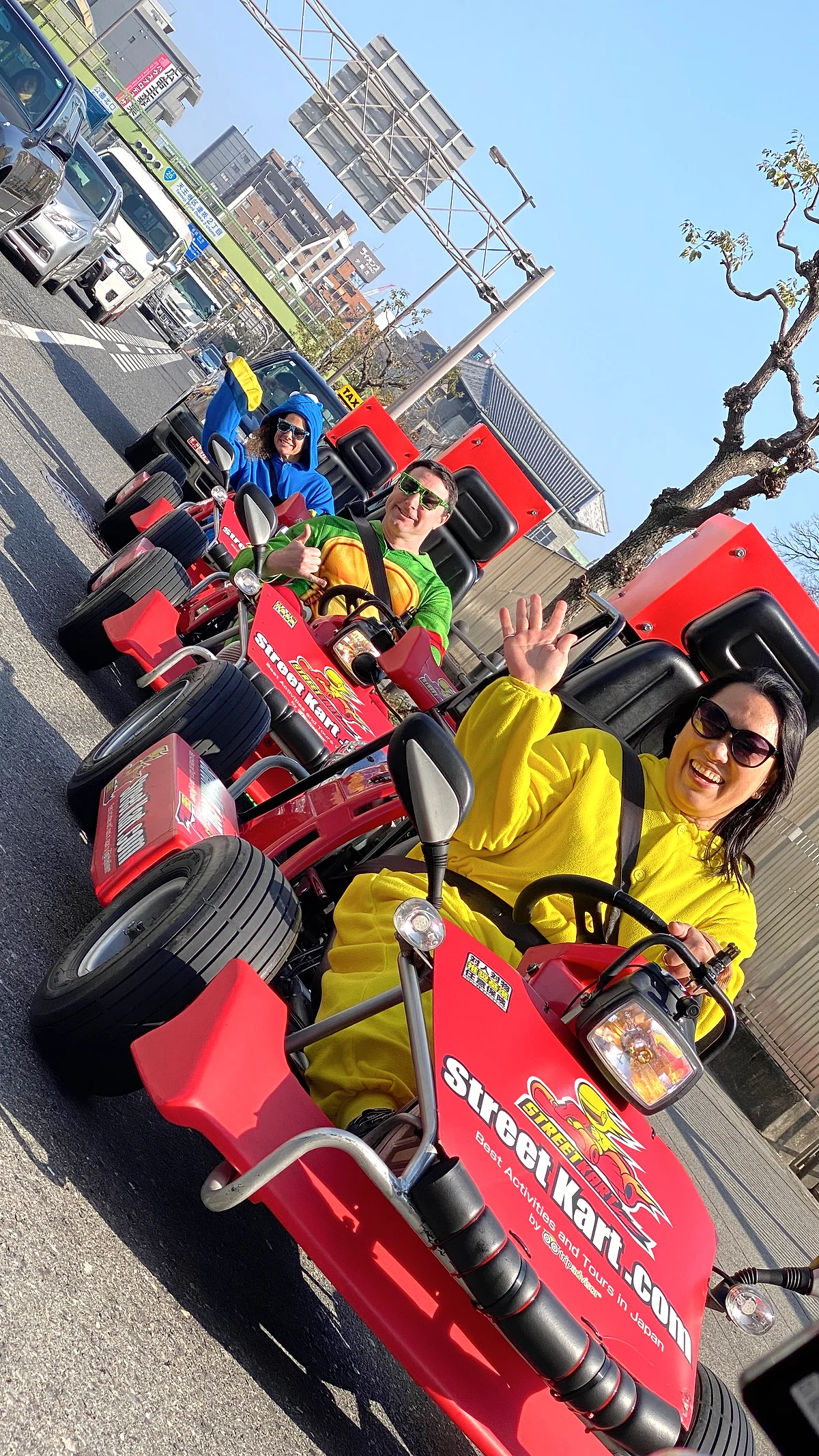
On Street Kart's Osaka tours, you drive on public roads following a guide. According to the company's materials, the tour passes through Amerikamura, Shinsaibashi, Dotonbori, and Namba. Namba is home to Namba Grand Kagetsu, the "holy ground of comedy." You'll be following your guide right through the middle of Minami.
From a kart, the changes in scenery flow by without a break. In my experience, sitting so much lower to the ground makes the buildings and signs seem to tower higher than usual. The sounds of the city come straight at you too, and you notice even more than on foot how the sound shifts when the street changes. From the calm streets of Minamihorie to Amerikamura, Shinsaibashi, and the center of Minami: changes that take 20 minutes on foot go by as fast as flipping pages.
One important point: while you're driving, focus on driving. It's not the time to pull out your phone and take pictures. Following Japan's traffic rules and your guide's instructions comes first. Save taking photos for the time you spend walking before or after the tour. In the kart, feel the flow of the city with your whole body; on foot, stop wherever catches your interest and take your shots. Splitting things up this way lets you really appreciate both.
Scenery you only glimpsed from the kart takes on new meaning when you walk it later. When you realize, "Oh, so this is the street we drove down earlier," the layout of Minami starts to come together in your head. For first-time visitors to Osaka, that matters more than you'd expect. Busy districts can be confusing even with a map, but once you've been through them, they're easier to get around on foot.
What Makes Street Kart Appealing for Couples and Pairs
First, a trained guide leads the way. You don't have to plan the route yourself, so you can focus on the scenery in front of you. Even if it's your first time driving on Japanese roads, you just follow the guide ahead of you. Even if you don't have much driving experience, the controls are explained before departure, and the guide leads the way.
Next, guidance on the day of the tour is generally in English. Whether guidance is available in Japanese or other languages depends on the staff that day, so it can't be guaranteed. If you have questions about guidance in languages other than English, please check the official website.
For anyone researching before booking: the website is available in 22 languages. However, the website's languages and the language of the guidance on tour day are two separate things, so keep that in mind.
The Osaka store's location also makes planning easy for two. It's in Minamihorie, about 5 minutes on foot from Amerikamura, about 15 minutes from Shinsaibashi, and about 20 minutes from Dotonbori and Namba. You can roll straight from the tour into a walk around Minami, before or after.
Also, the karts are single-seaters. You can't ride together, so if two of you join, each of you gets your own steering wheel. Watching the same scenery past your partner's back as they drive ahead of you feels different from looking out from the passenger seat. For details on how tours are arranged, please check the official website.
Finally, some numbers. As of November 2023, Street Kart had run more than 150,000 tours, served more than 1.34 million customers, and received more than 20,000 reviews, with an average rating of 4.9 out of 5.0 (all figures as of November 2023, across all stores). There are 9 stores nationwide (7 in Tokyo, 1 in Osaka, 1 in Okinawa), and the one Osaka store is in Minamihorie.
How Should the Two of You Plan a Limited Amount of Time?
When you're traveling in Osaka, you can only fit so much into a day. If seeing the scenery change is your main goal, deciding in advance whether to do the tour or the walk first makes things easier.
Personally, I like doing the tour first to see all of Minami, then walking to Dotonbori afterward. You retrace the streets you drove, this time at your own pace. Dotonbori is about a 20-minute walk from the store, so if you stop by Amerikamura and Shinsaibashi along the way, you can see again how the scenery shifted when you drove through.
Once you reach Dotonbori, make eating part of the walk. You've come to the city of kuidaore (eating till you drop), so it would be a shame to leave hungry. Among the restaurants in Street Kart's materials, Dotonbori has Kukuru for takoyaki, and Kinryu Ramen and Ichiran Dotonbori for ramen. For okonomiyaki, there's Chibo, about 10 minutes on foot from the store. If you'd like a calmer atmosphere, Hozenji Yokocho, about 20 minutes on foot from the store, has kappo and other Japanese restaurants. Step one street away from the sign-lit bustle and the mood changes completely. That's one more change of scenery.
If you have time before the tour, browsing the vintage shops in Amerikamura, about 5 minutes on foot from the store, is a good option. It's easy to get absorbed hunting for finds, though, so give yourselves plenty of time to get back so you aren't late for the tour's meeting time.
Please take the train to the store. The nearest station is Nishi-Ohashi on the Osaka Metro Nagahori Tsurumi-ryokuchi Line, about 3 minutes on foot, or Yotsubashi on the Yotsubashi Line, about 5 minutes on foot. Incidentally, the name "Yotsubashi" (four bridges) comes from the canals that once crossed here, with four bridges spanning them. The canals have been filled in, but the name lives on in the station. The "Horie" in Minamihorie is also a trace of this old city of waterways. Back to the point: the store has no parking, so we recommend coming by public transportation.
What to Check Before Booking
Weekends tend to fill up, so book early once your travel dates are set. Bookings are accepted via Facebook, LINE, and email (booking@streetkart.com). For available tour time slots and full participation requirements, please check the Street Kart official website.
To drive, you need a valid license that allows you to drive in Japan. Which licenses are accepted and what to bring on the day depend on your country and license type, so please check the driver's license page on the official website. The worst thing would be finding out on arrival that you can't drive, so check for both of you before you leave.
Prices vary by season and time of day, so please check the official website (kart.st) for current prices.
From the quiet streets of Minamihorie to the sign-lined riverside of Dotonbori, it's only about a 20-minute walk, but Osaka changes its face many times along the way. Ever since Yasui Doton dug his canal, this city has probably kept changing its look, lively with water, people, and signs. Feel that flow with your whole body in a kart, then capture it in photos on foot. When you look back through the photos on both your phones after the trip, you'll be able to remember the scenery in order: "the quiet café, the vintage shops, the arcade, and then the signs."
This article was originally written in Japanese and translated using AI. Some expressions may read unnaturally, and we appreciate your understanding. For the most accurate and up-to-date information, please refer to the official site at kart.st.
Street Kart is not affiliated with Nintendo or the Mario Kart series in any way. We do not provide costumes of Nintendo characters, and such costumes may not be worn during tours even if brought by participants.