
5 Steps for Choosing Where to Go Together After Your Street Kart Ride in Minami-Horie, Osaka
5 Steps for Choosing Where to Go Together After Your Street Kart Ride in Minami-Horie, Osaka
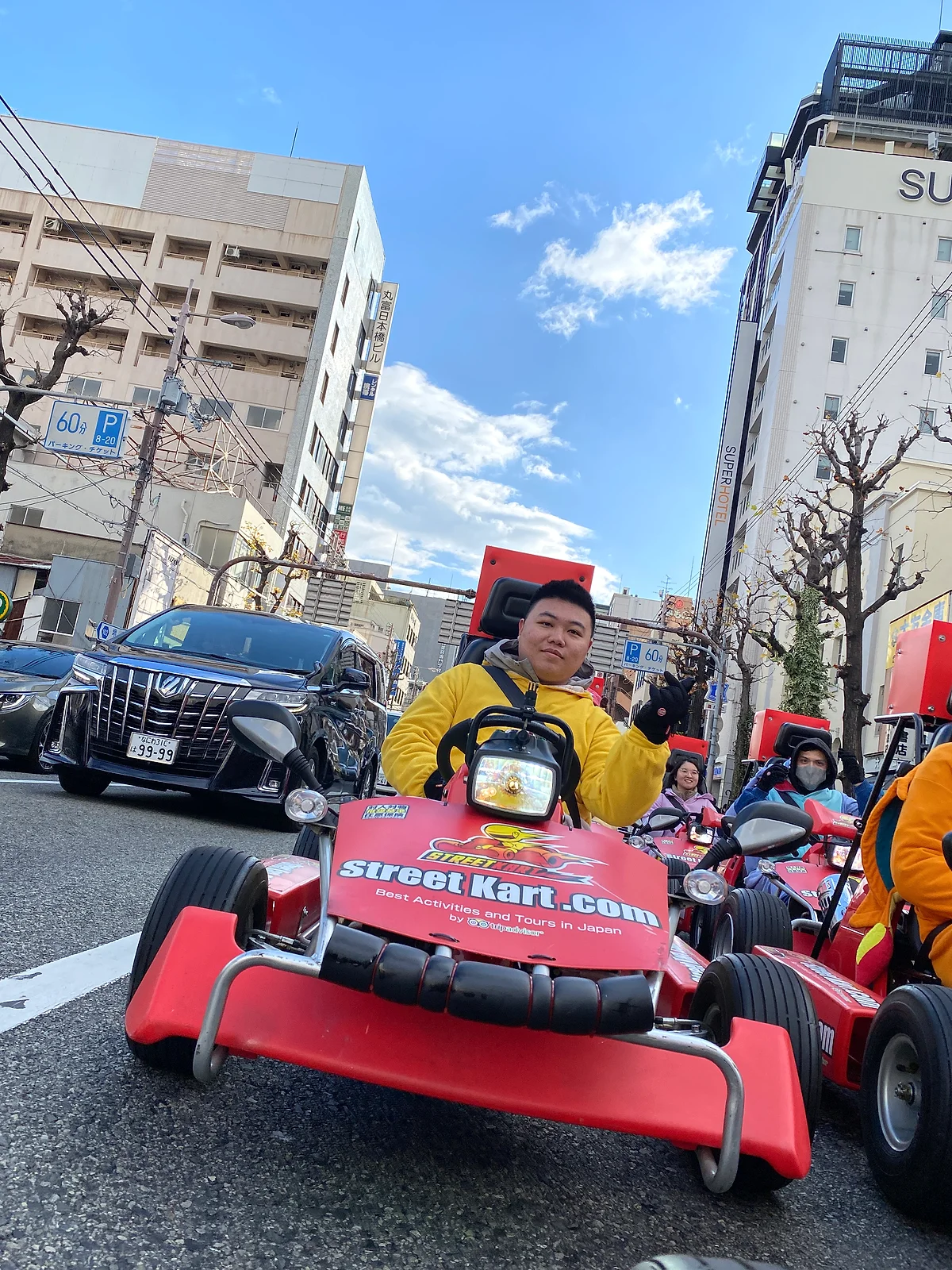
You climb out of the kart and your feet touch the ground. Your heart is still beating a little fast. You pull off your helmet and fix your hair with your fingers, then you look over at your travel partner, and you'll probably both say the same thing: "So, where do we go next?"
It's a harder question than it sounds. From Minami-Horie you can walk to Shinsaibashi, Dotonbori, and Amerikamura. With so many places close by, if you open your phone and start searching right there, you can end up standing outside the shop talking it over for 15 minutes. When two people are traveling on a tight schedule, that's time you don't want to lose.
This article is for first-timers. It walks through five steps for finding an easy place to stop after a street kart tour in Osaka. It won't tell you which spot is "the best." It's about how the two of you can pick a stop that suits you, without going back and forth.
Step 1: Get a mental map of where you'll finish
Before you look for somewhere to go, check where you'll be starting from. Street Kart's Osaka location is in Minami-Horie, in Osaka's Nishi Ward. The nearest station is Nishi-Ohashi on the Osaka Metro Nagahori Tsurumi-ryokuchi Line, a 3-minute walk away. Yotsubashi Station on the Yotsubashi Line is a 5-minute walk. For directions from Shinsaibashi or Namba Station, see the official website (kart.st).
A quick detour here. The name "Yotsubashi" means "four bridges." Long ago, two canals crossed each other in this area, and four bridges spanned them. The canals were filled in a long time ago, and today the spot is a wide avenue with cars racing by. The "hori" in "Horie" also comes from those canals (hori means canal or moat). People in old Osaka built their neighborhoods along the waterways and moved goods by boat. Knowing that, the intersection you pass every day starts to look a little different, doesn't it?
Back to the main point. This layout matters because two things mostly decide where you'll stop: how far it is from the shop, and which station you'll leave from at the end. If your hotel is near Namba, for example, you can stop at places as you walk south, and the walk doubles as your way back. If you pick a place in the opposite direction, you'll still have fun, but walking there and back will tire your feet. Later in a trip, that difference really starts to add up.
Here's another small thing that helps. The shop has restrooms and Wi-Fi. After your ride, take a breather inside and drop a pin on your next stop in Google Maps. It's much calmer than scrambling to look things up once you're outside. There's also a convenience store within a 5-minute walk, so it's easy to grab a drink before you head off.
Think about your luggage before you set out, too. The shop has lockers for small items, but they aren't meant for large bags like suitcases. None of the locations have parking, so public transportation is recommended. If you plan to check out of your hotel and then do the tour and your extra stop on the same day, leave your big bags at the hotel first. You'll be able to walk around much more freely.
By the way, when you search for a place on Google Maps, try both the Japanese name and the English name. More than once I've run into places that only showed up under one of them.
Step 2: Go back on foot to see the streets you just drove
This is the part I most want to get across. The Osaka tour runs through Amerikamura, Shinsaibashi, Dotonbori, and Namba. While you're driving, you follow your guide, and the scenery keeps rushing past. And of course, please don't touch your phone while you're driving. You sit low in the kart, so you feel the sounds and wind of the city directly. The signs above you look huge, and you see an Osaka that's completely different from the one you see on foot.
That makes the time after the tour a chance to check what you saw. The sign or street you caught a glimpse of from down low in the kart, you now go and see for yourself on foot. To me, this is the simplest and most satisfying way to decide where to go.
The closest spot to the shop is Amerikamura, a 5-minute walk away. It's packed with vintage clothing and streetwear shops, with Triangle Park in the middle. Locals all call it "Sankaku Koen" (Triangle Park), but its official name is "Mitsu Park." Map apps sometimes list it under that name, so it's good to know so you don't get lost. When you drove through, the wall colors and signs probably just blurred past. On foot, you can make out the prints on the T-shirts in the shop windows. Just wandering around together and browsing the vintage racks is enough to get a real feel for the neighborhood.
If you want to go a bit farther, Dotonbori is a 20-minute walk. The Glico sign is a well-known photo spot, and the Kani Doraku crab sign and Kuidaore Taro are in the same area. There's also a promenade along the Dotonbori River, so you can fit the river and the signs into a single shot. If you want photos of the two of you, don't try to take them from the kart. Wait until you're here, where you can take your time with the camera.
One photo tip: there's always a crowd in front of the signs. Instead of waiting for a shot with just the two of you, step back and include the crowd. The photo will capture the feeling of being in Osaka's busy downtown. If you want someone to take your picture, try asking "Shashin, onegai dekimasu ka?" ("Could you take a photo for us?"). People in Minami tend to get pretty into it when asked.
Step 3: Decide how far to go based on how much energy you have left
At first you might think, "We came all this way, let's see everything." But driving on streets you don't know takes more concentration than you'd expect. If you choose the distance based on how much energy you both have and how you feel, the rest of your trip will go more smoothly.
It helps to sort the spots around the shop into three distance zones.
First, the 5-minute walking zone. This covers Amerikamura and Yotsubashi, right next to Minami-Horie. If you both want to enjoy the afterglow a bit longer but don't want to walk much, this zone is plenty. Minami-Horie itself is full of stylish shops and cafés, so just taking a loop around the shop counts as a real stop.
Next, the 15, 20 minute walking zone. That's Shinsaibashi (15 minutes), plus Dotonbori and Namba (both 20 minutes). The Shinsaibashi-suji shopping street is covered by an arcade, so you can shop and walk without worrying about the weather. Daimaru Shinsaibashi is a 15-minute walk, and Takashimaya Osaka and Namba Parks are 20 minutes. If you leave from Namba Station at the end, the route you walk becomes your way home.
When you decide how far to walk, think about your footwear as well. For the tour, closed-toe shoes are recommended (sneakers are best), and you're asked to avoid heels and open-toe shoes. If you wear shoes like that, you can head off on foot after the ride without changing. In summer, a hat, sunglasses, sunscreen, and something to drink are also recommended. That goes double if you plan to walk 20 minutes after the ride.
Finally, the train zone. Kuromon Market is about 10 minutes away by train. Known as "Osaka's Kitchen," it's famous for seafood and street food. Abeno Harukas is 15 minutes by train and has the Harukas 300 observation deck. Osaka Castle is 20 minutes by train, and you can walk around the castle tower and Osaka Castle Park. Shinsekai, home to Tsutenkaku Tower, is also about 15 minutes by train. The area is known for its observation deck, kushikatsu restaurants, and Billiken. These spots suit couples who want to add one more big plan after the ride. Travel and sightseeing together make the timing hard to predict, though, so it's safer to save them for a day with room in your schedule.
Personally, I think the trick is to pick just one place within walking distance after the ride. That way neither of you is worn out by the end of the day. If that doesn't feel like enough, you can always save the train-zone spots for the next day.
Step 4: Pick just one: eat, see, or shop
Most of the time, you can't decide where to go because you haven't decided why you're going. So start by agreeing on one word together. Today, is it "eat," "see," or "shop"?
If you choose eat, Osaka's konamon is an easy choice. "Konamon" is Osaka's word for flour-based dishes like okonomiyaki and takoyaki, and you could call them Osaka's staple food. Chibo, an okonomiyaki restaurant, is a 10-minute walk from the shop. Shinsaibashi has Mizuno (okonomiyaki), and Dotonbori has Kukuru (takoyaki). For ramen, Dotonbori also has Kinryu Ramen and Ichiran Dotonbori. If you'd prefer a calmer meal, try Hozenji Yokocho, a 20-minute walk away. Kappo and traditional Japanese restaurants line its narrow stone-paved alley. It's just one street away from the crowds of Dotonbori, but it suddenly gets quiet.
If you go as far as Shinsekai, kushikatsu (deep-fried skewers) is another option. Well-known places include Daruma and Yaekatsu. At kushikatsu restaurants, the standard rule is no "double-dipping," meaning you can't dip a skewer back into the shared sauce after you've bitten it. If you need more sauce, scoop some up with a piece of cabbage and pour it on. Remember that and you won't get flustered at the restaurant.
On the topic of cultural differences, you don't need to tip at restaurants in Japan. If you leave money on the table the way you would in the US, the staff may think you forgot it and chase after you. When you walk into a restaurant and they ask how many people, hold up two fingers and say "Futari desu" ("Two people"), and they'll understand.
If you choose see, the easy way to pick is what Step 2 describes: walk back through the areas you drove. Try Triangle Park in Amerikamura, or the Glico sign and riverside promenade in Dotonbori. If you walk as far as Namba, Namba Grand Kagetsu, a well-known comedy theater, is another option after the tour. Pick one photo spot in advance so you don't end up wandering around aimlessly.
If you choose shop, good options include the vintage shops in Amerikamura, the Shinsaibashi-suji shopping street, Daimaru Shinsaibashi, and Namba Parks. For electronics, Bic Camera Namba is a 20-minute walk. When you need a break, grab a coffee at % Arabica in Shinsaibashi or at Starbucks Shinsaibashi, a 15-minute walk away, and talk over where to go next.
One note on payment. Accepted payment methods differ from shop to shop, so it's a good idea to carry some cash along with your card. If you run low on cash, you can use the ATMs at convenience stores near the shop.
Step 5: Plan your extra stop when you book
The last step is actually something you do before your trip. When you book the tour, roughly decide where you'll go afterward too.
The reason is simple: weekends fill up fast. If you can't get the date and time you want, you'll have to rework your whole post-tour plan. Book early and settle on something like "after the tour, walk to Dotonbori and get takoyaki at Kukuru." Then you won't have to think twice on the day.
It also helps to think ahead about how the weather could change your plans. In light to moderate rain, the tour runs as scheduled, and raincoats are provided free of charge. In heavy rain or a typhoon, the tour is canceled, and you can choose a shortened tour (with the difference refunded), a new date, or a full refund. On days with rain in the forecast, make the covered Shinsaibashi-suji shopping street your first choice so you won't have to scramble after the tour. Check the exact conditions on the official website before you book.
Bookings are accepted via Facebook, LINE, or email (booking@streetkart.com). Check the official website for the latest booking methods. Tours are generally guided in English. Guidance in Japanese or other languages depends on the staff that day and isn't guaranteed. If you have any concerns about language, contact them in advance so you can relax on the day. The website is available in 22 languages. Check the official website for the languages offered.
As for your driver's license, make sure in advance that yours lets you take part, including which license types are required and how International Driving Permits are handled. You can find details on the official driver's license page. You can't take part if you don't have the required documents on the day, so don't overlook this.
Tour length, requirements, and other details may change. Check the Street Kart official website before you book. It will also help you work backward to figure out how much time you'll have for your extra stop.
Osaka After the Kart, Decided Together
Looking back, it's all pretty simple. Check where you'll finish and which station you'll leave from. Walk back through the streets you drove. Choose a distance that fits your energy. Narrow it down to one goal. And plan your extra stop when you book.
Keep these five steps in mind, and when you climb out of the kart and ask "So, where to?", you'll both have the answer right away. For example, browse the vintage shops in Amerikamura, walk south down the Shinsaibashi-suji shopping street, and snap a photo with the Glico sign behind you in Dotonbori. Earlier you looked up at that sign from low in the kart, and now you see it from a little farther away. It's the same city, but it looks different. When you notice that difference, your memories of Osaka together get a little deeper.
From Yotsubashi, where four bridges once stood, to neon-lit Dotonbori. You drive a kart through this old canal town where boats once came and went, and then you walk it on your own two feet. As ways to enjoy Osaka go, I think that's a pretty stylish one.
Weekends fill up fast, so once your dates are set, book early through Facebook, LINE, or email. You can find the latest information on the Street Kart official website. Why not book your tour now and pick your first stop afterward while you're at it?
This article was originally written in Japanese and translated using AI. Some expressions may read unnaturally, and we appreciate your understanding. For the most accurate and up-to-date information, please refer to the official site at kart.st.
Street Kart is not affiliated with Nintendo or the Mario Kart series in any way. We do not provide costumes of Nintendo characters, and such costumes may not be worn during tours even if brought by participants.