Riding Osaka's Street Kart a Second Time? Look Up at the City's "Height"
Riding Osaka's Street Kart a Second Time? Look Up at the City's "Height"
Think back to your first ride. The feel of the steering wheel, the guide's back up ahead, the color of the next traffic light. That's probably about all you remember clearly, right?
That's completely normal.
On your first street kart ride, just keeping up with the group takes all your attention. The second time is different. Your body remembers the flow, so your eyes have some room to wander. This article suggests using that extra room to take in the "height" of Osaka's Minami district.
To Be Honest Up Front: Minami Isn't a Hilly Area
The theme this time is "views from the hilly parts of town." But I won't pretend here. The area from Minami-Horie, where the Osaka store is, through Shinsaibashi, Dotonbori, and Namba is a downtown district spread across low, flat land. If you show up picturing long uphill climbs or downhill roads that look out over the city, you'll probably be let down.
So does this theme just not work for Osaka? I wouldn't go that far.
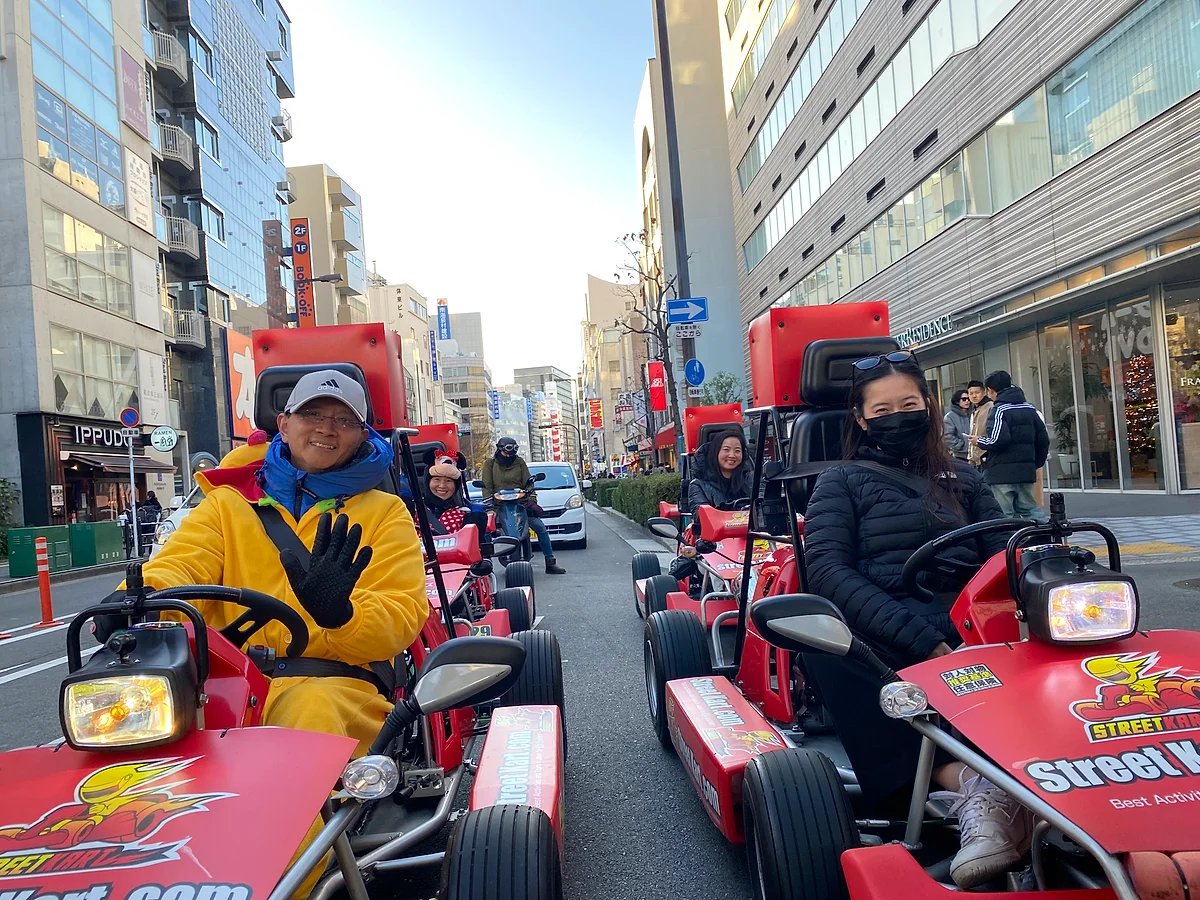
Street kart seats sit very low, putting your eyes just above the pavement. From there, even a slope or a bump in the road too small to notice on foot changes how things look a little. And in Minami, the place you really feel a "slope" isn't the road. It's the angle you tilt your head back to as buildings and signs climb up overhead.
So on your second ride in Osaka, enjoy the tilt of your gaze more than the tilt of the road. That's the answer this article offers.
What You See: First Ride vs. Second Ride
The first time, your eyes stay close. The taillights of the kart in front, the white lines on the road, the guide's hand signals. If someone asked you afterward which streets you drove down, the names might not come to you right away.
By the second ride, you have more room to look around. That said, the ground rule is that while you're moving, your eyes stay on the road ahead and on the guide. Only look up when you've come to a complete stop at a red light. Your sightseeing is limited to those short moments, but that's enough.
The trick is to pick one thing to look at before you set off. For example, "the top edge of the signs" or "the sky in the gaps between buildings." When you stop at a light, take a quick glance up at that one thing. Before the light turns green, bring your eyes back to the road and the guide. If you narrow it down to one thing, your eyes won't wander all over during the short stop, and you can switch back to driving without rushing.
By the way, the time at red lights you spent fidgeting through on your first ride ("come on, turn green already") becomes time for taking in the view on the second. It's the same red light, but it's worth a lot more.
The route follows each store's tour course. Based on the available information, the Osaka store's tour passes through Amerikamura, Shinsaibashi, Dotonbori, and Namba. If you're driving the same streets as last time, even better. You get to go looking for whatever you missed the first time.
Three Minami Views to Enjoy by Looking Up
Amerikamura: Low Buildings and Signs Up Close
Amerikamura is the center of Osaka's street culture, lined with vintage clothing shops and streetwear stores. At its heart is Triangle Park (Sankaku Koen). Amerikamura is about a five-minute walk from the Osaka store.
What makes this neighborhood fun is how close everything is: low buildings, plus signs and shop windows right at eye level. From the kart seat, the storefront displays sit slightly above you. Things that would be right in front of you on foot are now just a little higher up. That small shift sticks in your memory more than you'd expect.
On your second ride, pay attention to the balance between the width of the street and the height of the buildings. How much sky can you see? Remember that, and the contrast with Shinsaibashi and Dotonbori later will stand out clearly. This will be on the test. Okay, there's no test, but it really will pay off later.
When you pass near Triangle Park, look overhead in particular. The buildings stop at the park, so the sky should open up there. The low buildings around it and that open sky: if you remember how much "empty space" there is, it gives you a yardstick to compare against later.
Shinsaibashi and Dotonbori: Signs Looming Overhead
Shinsaibashi is one of Osaka's best-known shopping districts and home to the covered Shinsaibashi-suji shopping arcade. Head from there toward Dotonbori, and the density of the scenery changes completely.
Dotonbori means the Glico sign, the Kani Doraku crab sign, and Kuidaore Taro. Signs jut out across entire building walls, and when you look up from a low seat, they seem to loom right over your head. The sky you could see in Amerikamura is much narrower here. If you notice that change, you've nailed the second-ride experience.
Snapping one photo in front of the Glico sign and calling it a day? I get it. But that alone is a waste. Look up at the mass of signs from kart level, and the scene you know so well from photos turns into a three-dimensional wall pressing in on you.
When you look up during a stop, slowly trace a sign with your eyes from its bottom edge to its top edge. On your first ride you only remembered the pictures on the signs. Now you'll see how high they're stacked and how they cling to each building. Once you've finished tracing, bring your eyes back to the road ahead. This area is packed with people and cars, so only look up while you're fully stopped.
Namba: Rows of Building Walls Around the Station
Namba is Osaka's southern gateway. Namba Grand Kagetsu, Yoshimoto's comedy theater, is in this area too. You get to drive right past what people call the "holy land of comedy."
Once you leave the crowded signs of Dotonbori behind, what you look up at shifts from signs to the buildings themselves. Walls of commercial buildings line the streets, and the city should feel like it's grown a size larger.
On your first ride, you may have gone through this transition without noticing it. This time, follow how the sky changes, in order: Amerikamura, then Shinsaibashi and Dotonbori, then Namba. You're driving through a flat city, and yet it has real ups and downs in height. I think you'll feel that.
What I'd like you to compare here is your "distance" from what you're looking up at. In Dotonbori, the signs felt like they were hanging right over your head. In Namba, the building walls may seem to rise from a little farther back. It's all "looking up," but looking up at something close and looking up at something big feel quite different.
Keep in mind that the season, the weather, and the angle of the sun can make the signs' glow and the color of the sky look completely different. Of course you won't see the same view as last time, and that's part of the fun of a second ride.
Speaking of weather: in light to moderate rain, tours go ahead as scheduled, and raincoats are provided free of charge. On rainy days the sky feels lower, and the colors of the signs reflect off the wet pavement. You get a view where the city's lights spread out at your feet, not just above you. Tours are canceled in heavy rain or typhoons, though. Check the official website for the latest information on same-day decisions and what happens afterward.
Riding as a Pair? Plan Your Photos for "After You Get Off"
Karts are single-seaters, so you can't ride together. If two of you join, you'll each drive your own kart. Don't take out your smartphone while driving. I totally understand wanting to take pictures. But the basic rule is that while you're driving, you focus on driving.
So here's my suggestion: after the tour, walk the area and "check your answers" against the views you saw from the kart.
If your itinerary is tight, Amerikamura, five minutes on foot from the store, is just the right distance. Walk around Triangle Park, and the storefronts you were looking up at from the low kart seat are now at eye level. Same place, different view. Just chatting about the difference as you walk will make your trip memories much richer.
If you take photos, crouch down a bit and hold your phone low. You'll get a shot looking up at the signs and buildings from an angle close to what you saw from the kart. Put your partner in the foreground with the buildings behind them, framed from below, and that kart-level view comes back.
One more thing to try: go looking on foot for things that made you wonder "what was that?" while you were driving. The writing on a sign you couldn't make out from the kart, or what that storefront decoration actually was. Sometimes it turns out to be something totally different from what you thought, and that's part of the fun of checking your answers too. Bring back one small piece of homework from your ride so the two of you can go back and forth with "found it!" and "no, that's not it."
Dotonbori is about a 20-minute walk from the store. The Glico sign is a classic photo spot, and there's a promenade along the Dotonbori River.
The trick here is to take turns. One person stands under the sign, and the other crouches and shoots from below. That way you can capture the overwhelming feel of looking up at it from the kart.
If you pass through the Shinsaibashi-suji arcade on the way, stop under the roof and look up once. From the kart you were looking up at the sky and the signs, but here all you see is the roof. Then, as you come out from under it, the Dotonbori signs jump out at you all at once. That contrast of "closed, then open" is another way to savor Minami's height. If you go down to the riverside promenade, you can look up at the signs from yet another position than you get from the street.
Dotonbori gets a lot of foot traffic. When taking photos, step to the side of the walkway before you set up. If you stop suddenly in the middle, the people behind you will stumble into you. The crowds in Minami don't really stop for anyone.
If you have another half day, take the train about 15 minutes to Abeno Harukas, a 300-meter-tall building. The observation deck is called "Harukas 300," named straight after its height. Easy to remember.
You looked up at the city from just above the pavement in a kart, and now you look down on it from way up high. Seeing the same Osaka from both a low eye level and a high one shows you what kind of wider landscape that flat city you drove through sits in. As a way to wrap up a second tour, I'm a big fan of this combination.
Once you're up on the observation deck, try finding, together, which direction the Minami area you just drove through is in. How do the signs and buildings you were craning your neck to see from the ground look from above? Whether you find it or not, the time spent searching becomes part of your trip memories.
The Street Kart Appeal You Notice on a Second Ride
Things that ended at "that was fun" the first time start to show their substance the second time. Here's one point repeat riders tend to notice.
It's the guide-led system itself. On Street Kart tours, a trained guide drives at the front of the line. On your first ride, you were probably too busy keeping up to appreciate it. On your second, you can watch the guide's back up ahead a little more calmly. That alone changes how the tour feels quite a bit.
Things for the Two of You to Check Before Booking
First, the date. Weekends tend to fill up, so if you want to ride on a weekend, I recommend booking early. If your itinerary is flexible, adding weekdays as options gives you more days to choose from.
Booking methods and contact details are on the official website. Please check there.
Driver's license requirements are something you shouldn't skip checking just because you were able to ride last time. The documents you bring may change from trip to trip, and one of you may be in a different situation than before. For the latest participation requirements and what to bring, check the Street Kart official website.
The language of the tour is also worth confirming. On the day of the tour, guidance is basically given in English. Guidance in Japanese or other languages depends on the staff that day and isn't guaranteed. If this matters to you, check the official website in advance.
Prices vary by season and time of day, so please check the official website (kart.st) for the latest information.
Tour duration and departure times also differ by store and plan. If you plan to walk around Amerikamura or Dotonbori after the tour, work backward from your confirmed booking time to plan the rest of your day.
If you've already driven through Osaka on a street kart once, you know the outline of the city. This time, try adding height to that outline. The close storefronts of Amerikamura, the signs looming overhead in Dotonbori, the building walls growing larger in Namba. You're driving through a flat city, yet your gaze keeps moving up and down. Once you notice that, the same course turns into a completely different view.
After you get off, walk the same places together and check your answers. If you have energy left, finish by looking down from somewhere high up. Even with limited travel time, that alone makes your memories of Osaka much more three-dimensional.
Check availability and participation requirements on the Street Kart official website before making your plans. From the same low seat, you should see an Osaka that's a little different from last time.
This article was originally written in Japanese and translated using AI. Some expressions may read unnaturally, and we appreciate your understanding. For the most accurate and up-to-date information, please refer to the official site at kart.st.
Street Kart is not affiliated with Nintendo or the Mario Kart series in any way. We do not provide costumes of Nintendo characters, and such costumes may not be worn during tours even if brought by participants.